

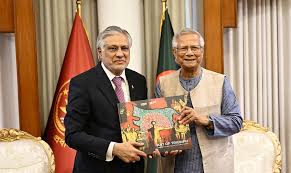
POBNEWS24, Dhaka Sept 2, 2025 : Pakistan’s Foreign Minister and Deputy Prime Minister Ishaq Dar recently visited Dhaka. This is the first visit to Bangladesh by a high-ranking Pakistani official in nearly 13 years. Pakistan is seeking to bring about a rapid change in the geopolitics of South Asia after the fall of Sheikh Hasina. The country’s Foreign Minister Ishaq Dar has announced a new chapter in relations by making a high-level visit to Bangladesh after 13 years.
Islamabad is mainly seeing diplomatic opportunities in post-Hasina Bangladesh. In such a situation, Dhaka-Islamabad relations are progressing in trade and diplomacy.
The report said that Ishaq Dar, upon landing at Hazrat Shahjalal International Airport in Dhaka, described the visit as ‘historic’ and said that it is the beginning of a new chapter in the revived partnership between the two countries. In his words, we need to work to create an environment where all the youth from Karachi to Chittagong, Quetta to Rajshahi, Peshawar to Sylhet and Lahore to Dhaka, work together to face challenges and realize their shared dreams.
His visit is being seen as a major step forward after months of diplomatic and military engagement. Pakistan-Bangladesh relations have warmed rapidly, especially since former Prime Minister Sheikh Hasina fled the country in August 2024 after being ousted in a student-led mass movement. Hasina was known to be close to India and is currently in exile in India.
However, former Pakistani diplomat Masood Khalid cautioned that the past still hinders the two countries from building trust. He said the new government in Bangladesh has responded positively to Pakistan’s initiatives, so that artificial obstacles in the way of relations have now been removed. But he believes that a framework is needed to remove misunderstandings through constructive dialogue to deepen relations.
After Sheikh Hasina was ousted, Pakistani Prime Minister Shehbaz Sharif met with Nobel laureate Muhammad Yunus, the head of the interim government, several times. Analysts did not expect relations to warm up so quickly.
In January this year, Bangladesh Army Lieutenant General SM Kamrul Hasan went to Islamabad and met with Pakistan Army Chief Field Marshal Asim Munir. Then in February, Bangladesh Navy Chief Admiral Mohammad Nazmul Hasan went. Then in April, Pakistan Foreign Secretary Amna Baloch visited Dhaka.
Then in May, Ishaq Dar’s visit was postponed due to a four-day clash between India and Pakistan. However, in July, Pakistan’s Interior Minister Mohsin Naqvi visited Dhaka. Finally, Dar came to Dhaka in August, at the same time as Bangladesh’s Quartermaster General Lieutenant General Mohammad Faizur Rahman. There, he met with General Sahir Shamshad Mirza, Chairman of the Joint Chiefs Committee of the Pakistani military.
Dilwar Hossain, a professor of international relations at Dhaka University, believes that Pakistan’s haste is strategic. He said that Pakistan has tried to normalize relations even during the Hasina government. Now they see an opportunity to revive relations like the post-1975 period.
He reminded that Ziaur Rahman, who came to power in 1975 after the assassination of Sheikh Mujibur Rahman, normalized relations with Pakistan. However, changes of regime in Bangladesh have often created tensions in relations with India and Pakistan. Pakistan may also want to exploit the current tensions in Bangladesh-India relations.
The history of Bangladesh’s independence still casts a deep shadow on bilateral relations. In 1971, millions of Bengalis were killed by the Pakistani army and its allied forces, and about two hundred thousand women were raped.
Former Pakistani Foreign Secretary Aizaz Chowdhury believes that Pakistan and Bangladesh must unite to confront Indian regional dominance. This dispute became apparent again in the four-day air war between India and Pakistan after the attack on Kashmir last May.
On the other hand, Dhaka University professor Shahab Enam Khan believes that although Dhaka-New Delhi relations are now somewhat cool, Bangladesh is prioritizing economic realities. He said that foreign policy is generally based on economics. Relations with Pakistan can be developed not only from a security or military perspective, but also on the basis of regional cooperation and economics.
China is currently increasing its influence in South Asia. Although Beijing is a close ally of Pakistan, it also had good relations with the Hasina government. China has maintained its position even after the interim government came to power. Yunus visited Beijing in March. In August, Bangladesh Army Chief General Waqar-uz-Zaman went on a week-long visit to China.
Bangladesh is considering buying 12 Chinese J-10C fighter jets. Pakistan is already using these fighter jets. China’s military and economic partnership with Pakistan is also deep. Analysts believe that these reasons may lead to closer relations between Dhaka and Islamabad.
During Dar’s two-day visit, he met with the head of the interim government, Dr. Muhammad Yunus and Foreign Affairs Advisor Towhid Hossain, held meetings with leaders of various political parties. These included the BNP, Jamaat-e-Islami and the student-led National Citizens Party (NCP), which played a leading role in the anti-Hasina movement.
Former Pakistani diplomat Abdul Basit said that these meetings are significant before the elections in Bangladesh in early 2026. He also said that Pakistan and Bangladesh will move forward in any situation. Past problems must be handled efficiently.
Both countries can also benefit economically. Currently, Bangladesh is maintaining a growth rate of 6 percent, while Pakistan’s growth is only 2.5 percent. Bilateral trade is also still limited. In 2024, Pakistan exported $661 million worth of goods to Bangladesh, while imports were only $57 million.
Dilwar Hossain of Dhaka University said that Bangladesh can import cotton, textiles, rice, cement, fruits and processed foods from Pakistan. On the other hand, Pakistan can import Bangladesh’s jute products, chemicals, hydrogen peroxide and tobacco products.
He noted that the combined population of the two countries is 430 million, which is more than double that of Western Europe.
However, the wounds of 1971 are still a big obstacle. Bangladesh still wants a formal apology from Pakistan. In addition, the issue of more than two hundred thousand Urdu-speaking Muslims living in Bangladesh is unresolved. They originally came to East Pakistan from Bihar, but after independence, Bangladesh did not grant them full citizenship rights and Pakistan is also reluctant to take them in.
In addition, the sharing of Pakistan’s state resources before the liberation war and the aid announced for East Pakistan after the devastating cyclone of 1970 are also still a matter of debate.
Nevertheless, former Pakistani Foreign Secretary Aizaz Chowdhury said that the people of the two countries are in favor of reconciliation. The people of Pakistan are equally saddened by the events of 1971. Now everyone wants to move forward.
Dilwar Hossain of Dhaka University said that even though Hasina was ousted, public opinion in Bangladesh regarding the liberation war has not changed. It is not possible to forget the past, but diplomacy is always dynamic. The two countries can increase cooperation in economy, diplomacy and culture, as well as continue the process of healing the wounds of the past.
Al Jazeera.