

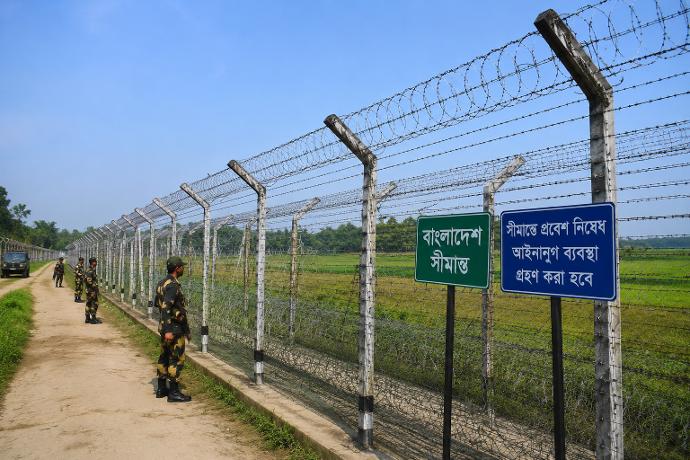
POBNEWS24 Dhaka, June 18, 2026 : Bangladesh Home Minister Salahuddin Ahmed has announced an initiative to build a barbed wire fence to curb border killings, infiltration and various cross-border crimes. There is no barbed wire fence on the border from Bangladesh side so far.
In response to a question raised on the table in the Parliament session on Wednesday, the Home Minister said that an initiative has been taken to build a barbed wire fence on the Myanmar border and the process of taking a plan to build a barbed wire fence at sensitive places on the Indian border is under consideration.
But how will this barbed wire fence be provided on the border, will any specific rules have to be followed – or will discussions with neighboring countries be required?
There is no universal law on the construction of facilities on the border internationally. Any sovereign country has the freedom to build facilities on its own border to ensure security and control immigration.
In some cases, bilateral agreements are also reached with neighboring countries regarding the construction of border structures.
For example, according to the agreement signed between India and Bangladesh in 1974, neither side can build a defense-capable structure within 150 yards of the zero line.
In addition, it was mentioned that even if developmental structures are built, consent must be obtained from the other side.
But Professor Sahab Enam Khan said that fencing one’s own border for security purposes falls within the jurisdiction of the state. In that case, there is no scope for any kind of obstruction from the neighboring country, said this teacher from the Department of International Relations at Jahangirnagar University.
However, there is a ‘norm and practice’ of not building physical structures during humanitarian crises such as wartime situations.
Professor Khan believes that Bangladesh is not breaking any rules in this initiative as there is already a barbed wire fence on the Bangladesh-India border from India.
But the push-in incident from India into Bangladesh has created a national security issue. Due to which he considers the decision to erect a barbed wire fence to be logical and moral.
“Although it does not violate international law, it is a position contrary to international practice. As a result, the Home Minister’s position can be made within the framework of national and international law,” said Professor Sahab Enam Khan.
On April 26, the Executive Committee of the National Economic Council – ECNEC approved the second phase of the border road construction project on the Bangladesh-Myanmar border, the total approved estimated cost of which is 3,666 crore 36 lakh 73 thousand taka.
Earlier, the estimated cost of the first phase was 3,860 crore 82 lakh taka.
The concerned said that the barbed wire fence can be erected as soon as possible once the border road construction work is completed.
Similarly, several structures will need to be constructed in advance to erect a barbed wire fence on the Bangladesh-India border. In that case, a large amount of money will be required, starting from land management to the construction of the border road and the construction of the fence.
However, Home Minister Salahuddin Ahmed told Parliament that only plans to build fences in ‘sensitive areas’ of the Indian border are under consideration.
Union Home Minister Amit Shah had informed the Parliament in the winter session that West Bengal, India has a 2,216-kilometer border with Bangladesh.
He said that out of this, 1,653 kilometers of barbed wire has been completed. However, 563 kilometers of border fencing is yet to be done in West Bengal alone.
The BSF could have carried out its activities such as searches, raids, etc., in the area up to 15 kilometers inside India from the zero line of the India-Bangladesh border.
BBC