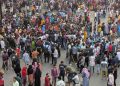

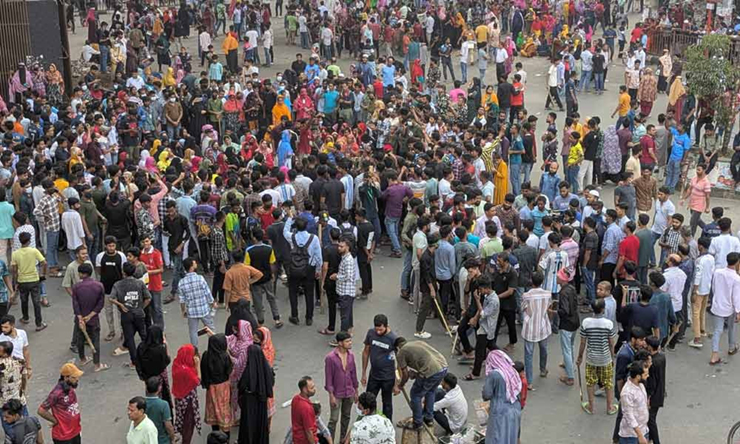
POBNEWS24, Dhaka, Nov 2, 2026 : The demand for a minimum wage of Tk 30,000 per month has sparked fresh unrest in Bangladesh’s ready-made garment industry. Protests, road blockades and clashes with police have taken place in major industrial areas from the capital Dhaka to Savar, Ashulia and Gazipur. Police have used tear gas and water cannons to control the situation. There have also been incidents of vandalism and burning of vehicles, police installations and police vehicles and factory property in some places in Gazipur. Production was halted in at least 529 garment factories on Sunday. The Bangladesh Garment Manufacturers and Exporters Association (BGMEA) said that this has disrupted the work of about 1 million workers.
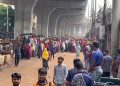
Although several factories opened on Monday, the situation has not returned to normal. Workers protested by taking up positions on various roads in Mirpur, Dhaka. In Gazipur, the Dhaka-Tangail highway and some important roads of Ashulia-Savar were also blocked in Kaliakoir. In some places, the protesters clashed with the police. Border Guard Bangladesh (BGB) has been deployed to maintain security in the industrial area of Gazipur. Some metro rail stations had to be closed for about two hours due to clashes in Mirpur. Services were later resumed.
At the heart of this movement is the long-standing wage dissatisfaction of the workers. Currently, the minimum monthly wage in the garment industry in Bangladesh is Tk 12,500. The workers are demanding that it be increased to Tk 30,000. In addition, there are demands to reinstate laid-off workers, stop the practice of blacklisting workers, and settle outstanding dues. According to the workers, it has become difficult to survive with their families on this wage at the current market rate. After paying the rent, rice and pulses, oil, vegetables, electricity, gas, transportation, and medical expenses, they have almost nothing left.
This dissatisfaction with wages is not new. In the latest wage structure, which came into effect from December 1, 2023, the minimum wage for garment workers was increased from Tk 8,000 to Tk 12,500. But labor organizations say that the wage is no longer effective in line with price increases. Babul Akhtar, general secretary of the Bangladesh Garments and Industrial Workers Federation, said that the wages of garment workers in Bangladesh are low compared to many countries in the world. According to him, if the owners cannot pay fair wages to the workers, then they should discuss increasing the prices of garments with international buyers. The industry cannot be run depending on the low wages of the workers.
The government formed a new six-member wage board on Sunday amid the movement. Labor and Employment Minister Ariful Haque Chowdhury announced this decision. The board is headed by Senior District and Sessions Judge Sheikh Ashfaqur Rahman. This board, consisting of workers, owners and neutral representatives, will review the new wage structure for garment workers and make recommendations. Babul Akhtar is on the board as a worker representative. However, it is not yet clear when the recommendations will be submitted and when the new wages will be effective. The Labor Minister has appealed to the workers to return to work.
According to the government, the problem can be resolved through discussions after the formation of a board to determine wages. Prime Minister Tarique Rahman has also held a meeting with the ministers concerned about the situation and ordered to maintain factory production and public safety. At the same time, the government has alleged that some political organizations are trying to create unrest behind the workers’ movement. However, according to the workers’ organizations, the main reason for the protests is the failure to resolve wage and workplace issues. As a result, if the movement is seen only as a result of political incitement, the real problems of the workers will remain hidden.
On the other hand, the owners have also expressed concern about the future of the industry. According to the BGMEA and the Bangladesh Knitwear Manufacturers and Exporters Association (BKMEA), the industry is under pressure from uncertainty in demand in the international market, increasing production costs, energy shortages and getting orders from foreign buyers at low prices. In this situation, if wages increase significantly all at once, production costs will increase. BGMEA President Mahmud Hasan Khan has warned that if workers do not return to work and production remains suspended, the employers may have to implement the ‘no work, no wages’ policy. The employers say that if factories remain closed, the workers’ income will ultimately suffer. The Bangladesh Workers’ Party has asked the government to accept the workers’ just demands.