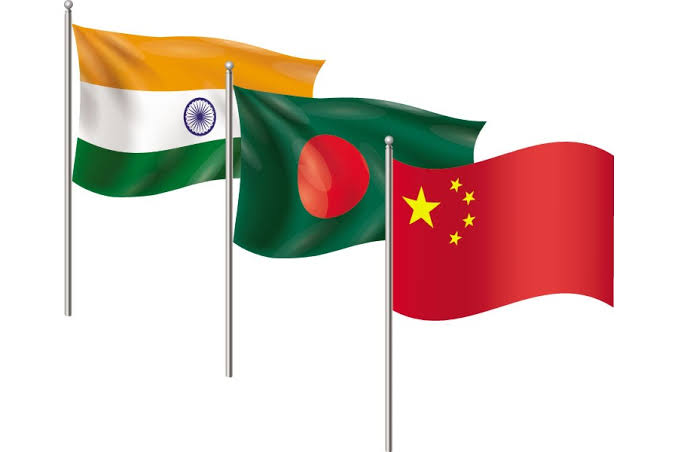
POBNEWS24, Dhaka, July 5, 2026 : The diplomatic equation in South Asia surrounding Bangladesh is changing rapidly. As economic, infrastructural and technological cooperation with China has reached new levels, New Delhi is closely monitoring the dynamics of the relationship. At the same time, the United States, Japan and European partners have also increased their efforts to deepen relations with Dhaka. According to international relations analysts, Bangladesh’s strategic location, rapidly developing economy and geopolitical importance centered on the Bay of Bengal are at the heart of this.
In the past few years, China’s relations with Bangladesh have not been limited to just large infrastructure projects. Now, discussions are underway to increase cooperation in industrialization, manufacturing, renewable energy, information technology, artificial intelligence, health, agriculture and special economic zones. Beijing also sees Bangladesh as an important economic partner in South Asia.
According to foreign policy analysts, China’s activeness is also having an impact on regional diplomacy. For India, Bangladesh is not just a neighbor; The Northeast is an important part of the connectivity, border security, common rivers, power trade and security framework of the Bay of Bengal. That is why every major development in Dhaka-Beijing relations is under the watchful eye of New Delhi’s policymakers.
However, analysts believe that there is no room to equate India’s observation with concern. According to them, any major neighboring country monitors changes related to its security and economic interests. Similarly, China also closely follows Bangladesh-India relations and the United States also evaluates Bangladesh’s position in the light of the Indo-Pacific strategy.
The Bangladesh government’s position is also clear. Government policymakers have repeatedly said that the country’s foreign policy is not centered on a single power; rather, it is being conducted based on national economic interests, multifaceted partnerships and balanced diplomacy. As a result, deepening relations with China does not mean weakening relations with any other partner.
However, the reality shows that global competition is now more evident around Bangladesh. China is interested in infrastructure and industrial investment, India is prioritizing regional connectivity and security cooperation, the United States is emphasizing trade, good governance, and the Indo-Pacific partnership, and Japan is active in long-term infrastructure development. In this multidimensional reality, every major diplomatic decision of Bangladesh is now gaining international importance.
According to experts, the next five years are very important for Bangladesh. If Chinese investment can bring tangible benefits in production, employment, and technology transfer, and at the same time, balanced relations with India, the United States, and other development partners are maintained, then Bangladesh will be able to transform this competitive geopolitical reality into economic opportunities.
On the other hand, if there is a failure to maintain balance, then unnecessary pressure, commercial uncertainty, or the risk of strategic misunderstandings may also arise in regional diplomacy.
According to the assessment of diplomatic circles, Bangladesh is no longer just a developing economy in South Asia; but an important “swing state” in the changing geopolitics of the Indian Ocean and Indo-Pacific region—the nature of relations with which may also affect the balance of regional power in the coming decades.

POBNEWS24 | The Politics of Bangladesh online Version | Reg No: 26/98
New diplomatic equation surrounding Bangladesh New momentum in relations with China, India in strategic calculations
Mir Afroz Zaman