

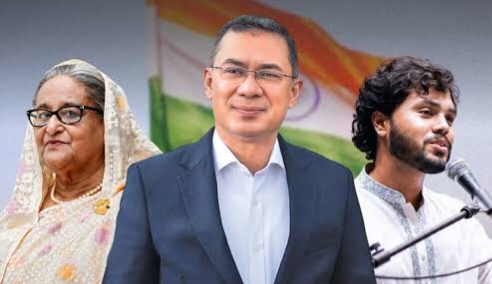
POBNEWS24, Dhaka Aug 17, 2026 : Uncertainty has once again arisen at the last minute surrounding Prime Minister Tarique Rahman’s possible visit to India. Although preparations for the visit and diplomatic contacts have been going on between the two countries for several weeks, Dhaka is now clearly saying that a ‘favorable environment’ needs to be created for relations before the Delhi visit. As a result, new questions have been raised about whether the possible visit from August 20 to 25 will finally take place or not.
A section of diplomatic observers believe that this situation is not only tied to the issue of Sheikh Hasina’s extradition; behind it are several diplomatic miscalculations by India in managing Dhaka-Delhi relations in the last two years. In particular, allowing Sheikh Hasina to stay in India, creating opportunities for her political statements from Indian soil, and Delhi’s slowness to build a relationship of trust with the new government of Bangladesh – these issues have further increased the political distance between the two countries.
In a meeting with India’s new High Commissioner Dinesh Trivedi in Dhaka on August 10, Prime Minister Tarique Rahman emphasized the need to create a “favorable environment” to advance bilateral relations. The issue of sending Sheikh Hasina back to Bangladesh also came up for discussion in the same meeting.
Bangladesh clarified the issue a few days later. On August 16, Foreign Ministry spokesperson Shahidul Karim said that discussions were underway on a visit to India, but a favorable environment was needed for the visit. At the same time, he said that Bangladesh was waiting for a response from Dhaka to Dhaka’s request for Sheikh Hasina’s extradition.
In other words, the Delhi visit is no longer a mere courtesy visit. It has become a political test of rebuilding trust between the two countries.
Since Sheikh Hasina left Bangladesh for India in August 2024, there have been major changes in the relationship between the two countries. Dhaka alleges that giving Sheikh Hasina political activities and opportunities to speak on Indian soil has created resentment among the people of Bangladesh.
The situation became more sensitive after Sheikh Hasina’s recent speech in Delhi on August 5. The Bangladesh government called his statement insulting to the country’s sovereignty. At the same time, India was informed that such political activities are very sensitive for the people of Bangladesh.
After that, a new reckoning began with Tarique Rahman’s visit to India. Several reports published in the Indian media also claimed that Tarique Rahman was unwilling to visit Delhi unless there was progress on the issue of Sheikh Hasina’s extradition. However, Dhaka did not officially announce such a condition in this regard.
From the point of view of diplomatic analysis, the biggest problem for India is that Delhi seems to have not understood the depth of political change in Dhaka and the public opinion-based position of the new government quickly enough.
India had a long-standing close relationship with Sheikh Hasina. During her government, Delhi gained important advantages in security, borders, communications and regional cooperation. But after the political changes of 2024, that old equation changed.
A large section of the Bangladeshi people have questioned India’s role in the new reality. In this situation, Delhi faced the challenge of quickly rebuilding relations with the new political reality and building trust with all parties.
But the Sheikh Hasina issue has repeatedly come to the fore in that restructuring process. As a result, while India’s efforts to normalize relations with the new government of Bangladesh have progressed, the shadow of old political relations has weakened that initiative.
Another embarrassing incident in India’s diplomatic management occurred in June. Prime Minister Tarique Rahman’s advisor, Jahedur Rahman, returned to Dhaka without entering India after a long interrogation at the Delhi airport. Bangladesh protested the incident and described India’s explanation as ‘unsatisfactory’.
The Indian Ministry of External Affairs said that he was allowed to enter after verifying the purpose of his trip at the airport; but he decided to return on his own.
The incident may have been a protocol or immigration issue on paper. But its political impact was huge. Because at that time, efforts were being made to rebuild Dhaka-Delhi relations. As a result, the incident raised questions about India’s behavior among the policymakers of the new government.
The importance of relations with Bangladesh for India is not limited to neighborly relations. Bangladesh is strategically important to India in all areas: connectivity with northeast India, border security, trade, energy, river water, the Bay of Bengal and regional connectivity.
On the other hand, there is no indication that Tarique Rahman’s government wants to adopt a permanent regional policy excluding India. Rather, Dhaka says it wants good relations with India. However, that relationship must be based on mutual respect, equality and Bangladesh’s national interests.
If Bangladesh wants to see India not as a rival, but as an equal neighbor, then many observers believe that a more politically sensitive diplomacy is needed instead of India’s old ‘security-first’ or influence-centric approach.
Another important aspect of Tarique Rahman’s foreign policy is to strengthen relations with China. The prime minister has already visited China and there has been interest between the two countries in infrastructure and economic cooperation. The fact that his first foreign visit was to China and Malaysia, bypassing India, has also been interpreted as a political message for Delhi.
Of course, this cannot be seen as a direct ‘anti-India’ stance. Bangladesh needs to maintain balanced relations with all major powers, including India, China and the US, in its interests.
But the message for Delhi is clear – Dhaka no longer wants a foreign policy that is overly dependent on any one country.
If Tarique Rahman finally visits Delhi, several important issues may come up for discussion. These include – Sheikh Hasina’s extradition; border killings and border management; trade and trade deficit; energy and power cooperation; transit and regional connectivity; water sharing; Teesta and Ganga waters; security and border cooperation; Indian investment in Bangladesh; connectivity with northeast India.
The water issue is likely to become even more important in the coming months, especially as the 1996 Ganga Water Sharing Treaty is set to expire in December this year. The question is, is India losing diplomatic leverage? This is the biggest question.
Delhi still has an opportunity. A direct meeting with Tarique Rahman will allow the leadership of the two countries to clarify their positions. For India, it is an opportunity to understand the new political reality of Bangladesh. Similarly, for Dhaka, it will create an opportunity to understand Delhi’s security and strategic concerns.
But if the visit is repeatedly postponed, it will not just be a state visit postponed; it could become a symbol of the lack of trust between the two countries.
An even bigger risk for India is that if another power gradually starts filling the gap in relations with Bangladesh, not only political influence but also economic and strategic benefits could suffer.
‘Diplomatic failure’ – how logical is it?
It would not be right to unilaterally place the entire responsibility for Tarique Rahman’s uncertain visit to India on India. Bangladesh’s internal politics, the Sheikh Hasina issue, public pressure and the new government’s own foreign policy are also playing an important role.
However, the main test of diplomacy is to adapt quickly to the changing political reality. If some of Delhi’s decisions and reactions in that area have increased the crisis of trust with Dhaka, then there is enough reason to see it as part of India’s diplomatic failure.
Because one thing is now clear—Bangladesh-India relations are not where they were before. The political equation of Sheikh Hasina’s tenure is over. To build relations with the new government, Delhi will have to move forward with a new language, new priorities and new political sensibilities.
Whether Tarique Rahman’s visit to Delhi will finally happen or not, the bigger question is—is India understanding the changing political reality of Bangladesh quickly enough?
The answer to this question can determine the course of Dhaka-Delhi relations in the future.