

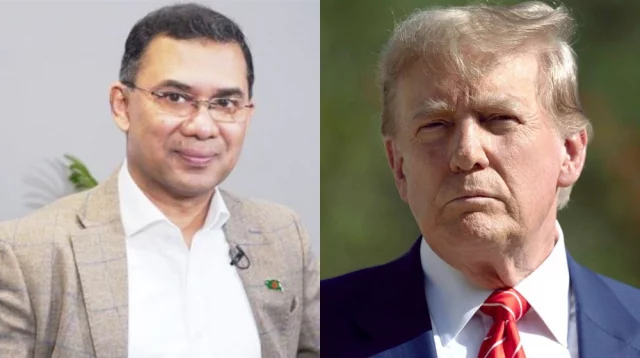
POBNEWS24, DHAKA, Sept 1, 2026 — U.S. President Donald Trump has signalled his interest in meeting Bangladeshi Prime Minister Tarique Rahman in the near future, while thanking Dhaka for its decision to purchase Boeing aircraft in a message that could point to a broader economic and strategic reset in Bangladesh-U.S. relations.
In a letter sent to Rahman on Aug. 31, Trump said he looked forward to meeting the prime minister “in the near future” and extended warm wishes to the people of Bangladesh, expressing hope for a “very bright future” for the country under Rahman’s leadership.
Trump also thanked Bangladesh for choosing Boeing, saying: “Boeing will not let you down, and I will not forget.”
The message comes at a potentially significant moment for bilateral ties, with trade, aviation and wider U.S. economic interests increasingly featuring in Washington’s engagement with Dhaka.
A day before Trump’s letter, U.S. Special Envoy and Ambassador to India Sergio Gore said Bangladesh had made a new commitment to purchase additional Boeing aircraft from the United States. The proposed agreement could involve several billion dollars in additional spending, according to Gore.
The convergence of the Boeing commitment and Trump’s expression of interest in meeting Rahman could make trade and economic ties a key item on the agenda of any future high-level talks.
For Washington, the aircraft deal represents more than an aviation transaction. It supports U.S. manufacturing, exports and jobs — priorities closely aligned with Trump’s “America First” approach to international economic relations.
For Dhaka, closer economic engagement with the United States could provide opportunities in aviation, investment, technology, energy and exports while helping modernise the country’s commercial aviation sector.
But the potential meeting could also extend well beyond Boeing.
Trade, defence and the Indo-Pacific
When Trump previously congratulated Rahman on becoming prime minister, he also highlighted the importance of maintaining momentum in bilateral trade, as well as defence cooperation and Bangladesh’s access to advanced U.S.-made military equipment.
Three broad areas could therefore assume particular importance in any future Trump-Rahman talks: trade and investment, defence and security, and regional geopolitics.
The United States remains one of Bangladesh’s most important export markets, while Washington has an interest in expanding access for American goods, services and investment in the Bangladeshi economy.
Defence and maritime security could also feature prominently. Bangladesh’s position on the Bay of Bengal and its wider importance to the Indo-Pacific give Dhaka strategic significance for Washington, potentially bringing maritime security, defence equipment and regional cooperation into the discussion.
The geopolitical dimension may prove more sensitive.
A deeper U.S.-Bangladesh relationship will inevitably intersect with Washington’s broader Indo-Pacific strategy and Dhaka’s relations with India and China.
For Bangladesh, that creates both an opportunity and a diplomatic challenge.
Closer ties with Washington could generate greater access to U.S. investment, technology, energy cooperation, export opportunities and defence capabilities. At the same time, stronger strategic engagement with the United States could bring heightened expectations from Washington.
Dhaka’s challenge will be to deepen its partnership with the United States without allowing closer ties with Washington to unnecessarily complicate its relationships with other major powers, particularly India and China.
A warm message, but also a strategic signal
Trump’s expression of goodwill towards Bangladesh and his optimism about the country’s future under Rahman carry clear political weight. But diplomatic relations are ultimately driven less by personal warmth than by national interests.
That is particularly relevant under Trump, whose foreign-policy approach places strong emphasis on trade, U.S. industry, economic returns and strategic interests.
For Dhaka, therefore, the significance of Trump’s message may lie not simply in the prospect of a leaders’ meeting, but in what Washington may seek from a closer partnership — and what Bangladesh can secure in return.
There is, however, no indication so far of a confirmed date, venue or schedule for a Trump-Rahman meeting. The development is therefore better understood as a strong diplomatic signal of possible high-level engagement rather than confirmation that a summit has been finalised.
If such a meeting takes place, it is unlikely to be merely ceremonial.
Boeing may have opened the door, but the agenda could extend to trade, investment, defence, the Bay of Bengal, the Indo-Pacific and Bangladesh’s strategic position between competing regional interests.
The central question for Dhaka will be what it wants from Washington as the two countries seek to define the next phase of their relationship.
Ultimately, the success of any Trump-Rahman meeting will not be measured by the photographs from the negotiating table, but by the economic and strategic gains Bangladesh can secure afterwards.
The Boeing deal may have opened the door. The larger question is how far Dhaka can walk through it.