
By Mir Afroz Zaman
POBNEWS24, Dhaka Oct 3, 2026 : A celebration of khadi in Dhaka brought together history, craftsmanship and contemporary fashion on Friday, October 2, highlighting the enduring cultural significance and future potential of one of South Asia’s most distinctive handwoven textiles.
Titled ‘Khadi Kotha’, the event was organised at the Indira Gandhi Cultural Centre (IGCC) of the High Commission of India in Dhaka to mark the 157th birth anniversary of Mahatma Gandhi. The programme explored khadi as a symbol of self-reliance, sustainability and a shared cultural heritage, while showcasing its growing relevance in contemporary fashion.
Dinesh Trivedi, High Commissioner of India to Bangladesh, attended the event, which also featured activities centred on Gandhi’s ideals of truth, non-violence and selfless service.
The programme brought together students and young people through poster and quiz competitions, an interfaith prayer and cultural performances. A dedicated khadi exhibition offered visitors an opportunity to explore the fabric’s traditional craftsmanship and its evolution into contemporary clothing.
One of the highlights of the event was a special presentation by renowned Bangladeshi fashion designer Biplab Saha, who demonstrated how the distinctive texture and character of traditional khadi can be reinterpreted through modern silhouettes, colours and design.
The presentation underscored a broader transformation taking place within Bangladesh’s textile and fashion landscape: traditional fabrics are increasingly being rediscovered and adapted for contemporary lifestyles without losing their cultural identity.
A living tradition of the subcontinent
Khadi is more than a textile. It represents a long tradition of hand-spinning and hand-weaving deeply connected with rural livelihoods, artisanal skills and local economies across the Indian subcontinent.
The spinning of yarn and weaving of cloth by hand have been part of Bengal’s textile heritage for generations. Produced through traditional techniques and the skills of local artisans, khadi carries the distinctive character of handmade fabric while reflecting the communities and craftsmanship behind its production.
Khadi acquired additional historical significance during the colonial period, when locally produced textiles became closely associated with economic self-reliance and the rejection of dependence on imported cloth. Under Mahatma Gandhi’s leadership, the spinning wheel and khadi became powerful symbols of self-sufficiency and the Swadeshi spirit.
That history has given khadi a significance that extends well beyond clothing. It has come to represent dignity of labour, community-based production and the idea that cultural heritage can also serve as a foundation for economic independence.
Kumilla khadi: a distinctive Bangladeshi heritage
In Bangladesh, Kumilla khadi occupies a particularly important place in the country’s textile heritage. Generations of weavers and artisans in the Kumilla region have contributed to the development and preservation of the craft, making khadi an integral part of the area’s cultural and economic identity.
The fabric’s distinctive texture, comfort and handcrafted character have helped it retain a loyal following while creating opportunities for new interpretations in fashion.
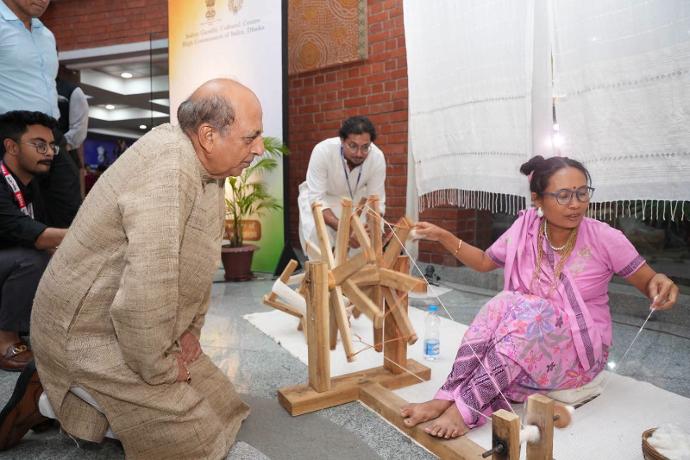
At ‘Khadi Kotha’, this heritage was represented through stalls featuring khadi textiles from Friendship (Nodi Limited) and Kumilla Khadi Ghar. Visitors were able to see and explore a range of khadi fabrics and garments, while a live demonstration of traditional spinning on the charkha, or spinning wheel, offered a direct glimpse into the craftsmanship behind the textile.
The demonstration connected the finished garments on display with the labour-intensive traditional process from which they originate—from spinning yarn to weaving fabric.
From the spinning wheel to the fashion runway
Khadi was once primarily associated with traditional clothing. Today, however, designers are increasingly experimenting with the fabric across a much wider range of garments, including sarees, panjabis, kurtas, shirts, dresses, jackets and contemporary fashion pieces.
Designers such as Biplab Saha are helping to expand the visual language of khadi by combining its traditional texture with modern cuts, colours and construction techniques.
The result is a new interpretation of an old textile—one that preserves the character of handmade fabric while making it relevant to younger and more diverse audiences.
Khadi and the future of sustainable fashion
The renewed interest in khadi also comes at a time when the global fashion industry is increasingly examining sustainability, responsible production and the environmental and social costs of mass manufacturing.
Khadi’s connection with local artisans, traditional skills and decentralised production gives it potential relevance within this broader conversation. Supporting the sector can help preserve traditional craftsmanship while creating economic opportunities for weavers, spinners and small-scale producers.
For Bangladesh, strengthening the khadi value chain could therefore serve two purposes: safeguarding an important element of the country’s cultural heritage while opening new avenues for sustainable fashion and local enterprise.
‘Khadi Kotha’ offered a platform where these different dimensions came together—history and modernity, craftsmanship and design, tradition and sustainability.
From the rhythmic movement of the spinning wheel to the contemporary fashion presentation, the event demonstrated that khadi is not simply a fabric of the past. It remains a living tradition capable of evolving with the times.