

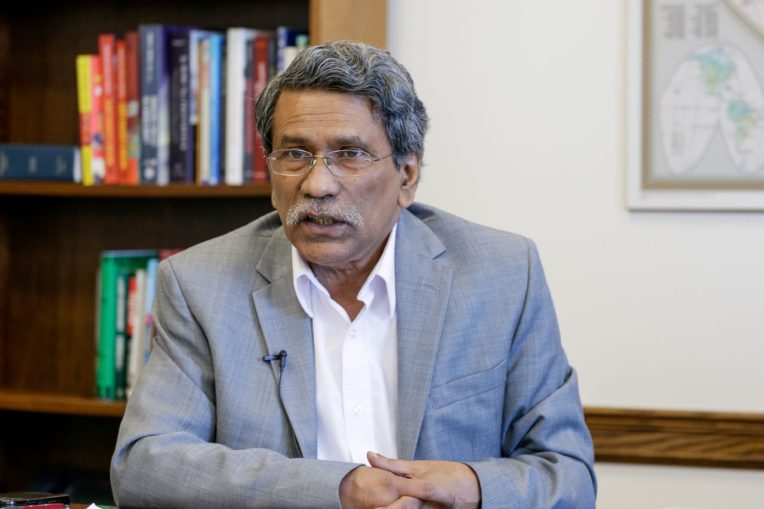
Mir Afroz Zaman
POBNEWS24, DHAKA, Oct 4 , 2026— The politicisation of state institutions is at the heart of Bangladesh’s longstanding political crisis, while resistance within the bureaucracy has emerged as a major obstacle to institutional reform, political scientist Ali Riaz said on Sunday.
Riaz, who headed the interim government’s Constitution Reform Commission, made the remarks at the “The Author’s Table” session of the Bay of Bengal Conversation at the Pan Pacific Sonargaon Hotel in Dhaka on October 4, 2026.
Speaking on “Can Bangladesh Break the Cycle?”, a discussion based on his book A Fractured Path, Riaz said Bangladesh’s political crisis should be understood primarily through the politicisation of state institutions, particularly since 1991, rather than through the events of 1947 or 1971.
“After 2009, it simply became an instrument of one party,” Riaz said, referring to the state machinery.
He said politicisation involved both ruling political forces and sections of the bureaucracy willing to operate under political masters.
Riaz also criticised the bureaucracy’s response to reform efforts, saying his experience of working with government officials for 15 to 16 months—including about nine months during the reform process—had convinced him that significant sections of the bureaucracy were resistant to structural change.
“First, they are opposed to reform. Second, rather than acting as a bureaucracy, they prefer serving political masters as political actors,” he said, while acknowledging that the assessment was a broad generalisation.
According to Riaz, the resistance persisted even after the July Uprising, which he described as a rejection of the old political order. He said he had seen little willingness within the bureaucracy to embrace institutional change and alleged that obstacles had been created to slow or prevent reforms.
Riaz, however, said it was too early to conclude that Bangladesh could not break its cycle of political instability.
“I am optimistic,” he said, explaining that he would not have led the Constitution Reform Commission or spent months working with political parties at the National Consensus Commission if he did not believe meaningful change was possible.
The outcome, he said, would ultimately depend on whether political forces were prepared to undertake the necessary changes.
Executive power
Riaz also raised concerns over the concentration of executive authority under Bangladesh’s existing constitutional framework.
He argued that the Constitution places substantial power in the hands of the prime minister, including influence over appointments to key state institutions. Excessive executive influence over the judiciary and other institutions, he said, needs to be addressed if Bangladesh is to achieve a sustainable democratic transition.
He further said an independent judiciary and Election Commission would be essential to such a transition.
Riaz also characterised the July Uprising as a rejection of the country’s political parties, arguing that political parties subsequently “recaptured the space”.
The remarks come amid continuing debate in Bangladesh over institutional reform following the July Uprising and the subsequent efforts to restructure key state institutions.
For Bangladesh to break what Riaz described as a recurring cycle of political instability, he said reforms would have to go beyond changes in political leadership and address the institutional structures through which power is exercised.
The Bay of Bengal Conversation, being held in Dhaka, brings together political leaders, diplomats, academics, researchers and other policy stakeholders from Bangladesh and abroad.