

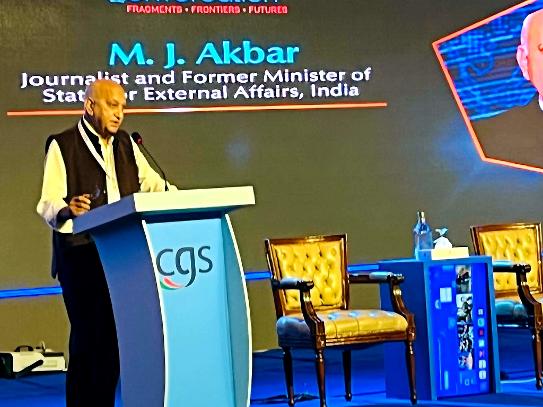
Mir Afroz Zaman, POBNEWS24, DHAKA, Oct 4, 2026 : Temporary political and diplomatic strains may test Bangladesh-India relations, but they cannot erase the deep historical and cultural ties between the two countries, former Indian Minister of State for External Affairs and journalist M.J. Akbar said on Sunday.
Akbar made the remarks while delivering a strategic address titled “Five Seas, One Gathering Storm” on the second day of the Bay of Bengal Conversation 2026, held at the Pan Pacific Sonargaon Hotel in Dhaka.
Referring to the current challenges in bilateral relations, Akbar acknowledged that relations between neighbouring countries can experience periods of tension and uncertainty. But, he suggested, temporary crises should not be allowed to define the broader relationship between the two countries.
He called for a shift in the way difficult bilateral issues are approached, arguing that policymakers should ask not only “what is possible”, but also “why is it not possible.” Such a change in perspective, he said, could open up new possibilities for addressing complex problems.
Akbar also highlighted the importance of history, language and culture in shaping Bangladesh’s national identity. He referred to the Bengali language and the region’s shared cultural heritage as important elements in understanding the broader relationship between Bangladesh and India.
Sovereignty and mutual respect
The former Indian minister also stressed the importance of respecting national sovereignty in international relations.
A failure to respect the sovereignty of states, he argued, could contribute to greater instability and disorder in the international system. His remarks came against the backdrop of a rapidly changing geopolitical environment in which established regional and global relationships are under increasing pressure.
Akbar also addressed the changing nature of warfare and international conflict.
He argued that conflicts in the 21st century cannot be fully understood through the traditional framework of 20th-century wars. Contemporary conflicts, he said, often emerge, subside and re-emerge in different regions, contributing to a persistent sense of global instability.
Reflecting on the history of the 20th century, Akbar suggested that the Cold War could also be viewed, in a broader sense, as a global conflict. While the confrontation between the major powers remained relatively “cold” in Europe, he noted, its consequences were far more violent in parts of Asia and Africa.
He also stressed the importance of examining the origins and historical context of conflicts rather than judging them solely by their immediate consequences.
Geopolitics of the Bay of Bengal
The three-day Bay of Bengal Conversation 2026 has brought together politicians, diplomats, researchers, economists and media professionals from several countries.
This year’s theme is “Fragments, Frontiers, Futures: Navigating Power, Technology and Trust in a World Rewritten.”
Discussions at the conference are focusing on shifting geopolitical dynamics in the Bay of Bengal, global power realignments, security, technology, climate, international trade and changing relations among states.
Akbar’s address placed Bangladesh-India relations within this wider regional and global context, while underscoring dialogue, mutual respect and the longer-term foundations of relations between neighbouring states.