
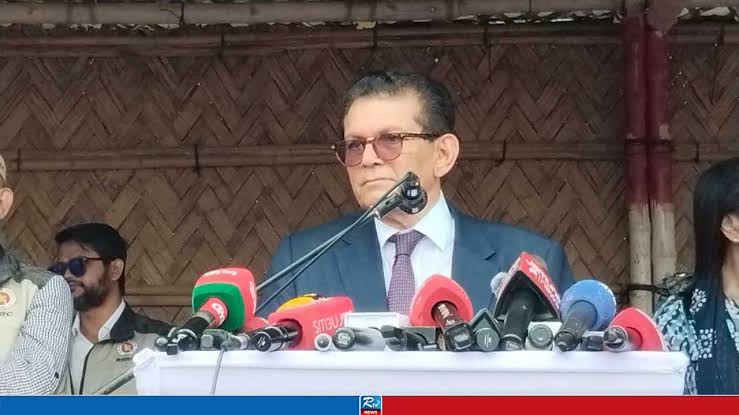
POBNEWS24, UKHIYA, COX S BAZAR (BANGLADESH) NOV 20, 2026 — Dr Khalilur Rahman, President of the 81st Session of the United Nations General Assembly, has called for urgent accountability and justice for the perpetrators of atrocities against the Rohingya, urging the international community to ensure the full implementation of the International Court of Justice’s (ICJ) landmark ruling recognising the atrocities committed against the minority community as genocide.
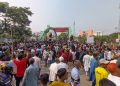
Speaking at a gathering at a football field inside a Rohingya refugee camp in Ukhiya, Cox’s Bazar, at around 8:30 am on Friday, Rahman outlined four key priorities: bringing those responsible for genocide to justice, ensuring the safe and dignified repatriation of Rohingya refugees, securing reparations and humanitarian assistance, and preventing future atrocities.
The gathering was attended by representatives of the Rohingya community, officials from the Bangladesh government and the United Nations, and members of the media.
At the beginning of his address, Rahman paid tribute to the Rohingya who lost their lives during Myanmar’s brutal military crackdown in 2017.
“Yesterday, November 19, the highest court of the United Nations spoke in The Hague. It spoke the name of the Rohingya. Its decision is clear: what happened to them in 2017 was genocide,” he said.
He described the ruling as historic, saying that, for the first time, the International Court of Justice had held a state responsible for committing genocide.
According to Rahman, the Court found that Myanmar’s security forces had carried out widespread killings, sexual violence and abuses against women and children in northern Rakhine State, with the intent to destroy a substantial part of the Rohingya population.
He said at least 10,000 people had been killed, entire villages had been wiped out, and the atrocities had been committed with the intention of destroying the Rohingya community. The Court had also recognised the Rohingya as a distinct ethnic group in Myanmar.
“No court ruling can bring back those who have died or heal every wound. But justice begins with establishing the truth,” Rahman said, adding that the ruling had internationally affirmed the truth of the Rohingya people’s decades-long suffering, persecution and deprivation.
Four Priorities for Implementing the ICJ Ruling
Emphasising that the ICJ’s ruling is final and binding, with no avenue for appeal, the UN General Assembly President said its implementation must go beyond paper commitments and produce tangible changes in people’s lives.
He identified four priority areas:
1. Accountability and Justice
Rahman called for investigations, prosecutions and appropriate punishment of individuals suspected of involvement in crimes under the Genocide Convention.
He said Myanmar must take effective steps to ensure accountability and undertake necessary reforms to its national laws and judicial system.
2. Safe, Voluntary and Dignified Repatriation
He stressed that Rohingya refugees must be able to return to Myanmar voluntarily, safely and with dignity.
Such a process, he said, must guarantee citizenship rights, freedom of movement and protection against discrimination and persecution.
“No Rohingya should be sent back to an unsafe environment,” he emphasised, adding that the wishes, views and aspirations of the Rohingya themselves must remain central to any repatriation initiative.
3. Reparations and Humanitarian Assistance
Rahman called for adequate compensation for Rohingya victims and communities affected by the atrocities.
Where restitution of property is no longer possible, he said, appropriate reparations must be provided to individuals and communities.
He also urged the international community and development partners to increase financial and humanitarian support for Rohingya refugees until safe repatriation becomes possible.
“This responsibility must not be left to Bangladesh alone,” he said, calling for greater international solidarity, assistance and funding.
4. Prevention of Future Atrocities
The UNGA President stressed the need for effective legal and institutional reforms in Myanmar to prevent a recurrence of such atrocities.
He called for reforms in the security sector, improved training of security personnel, stronger civilian oversight and effective measures to guarantee the safety and security of the Rohingya population.
Failure to Implement Ruling Would Undermine International System
Responding to a question from journalists, Rahman said the UN General Assembly could consider taking action if the ICJ ruling was not implemented.
He described the verdict as a landmark decision and said it was currently under review.
He warned that failure to comply with the ruling would undermine confidence in the international system established through international institutions and multilateral cooperation.
“Unless this ruling is implemented, the entire international system built through the international community and various institutions will be called into question,” he said.
Referring to Article 94 of the UN Charter, Rahman noted that all UN member states are obligated to comply with decisions of the International Court of Justice.
He said that if a state failed to fulfil its obligations under an ICJ ruling, the matter could be brought before the UN Security Council. As President of the General Assembly, he pledged to continue consultations with member states on the issue.
Gratitude to Bangladesh and International Partners
Rahman expressed gratitude to The Gambia, the Organisation of Islamic Cooperation (OIC), the 11 states that intervened in the case, the UN investigative team, and the government and people of Bangladesh for their contributions to the historic legal effort.
He also praised the hospitality and generosity of local communities in Ukhiya and Teknaf for sheltering Rohingya refugees.
Paying tribute to the courage of survivors, particularly women who testified before the Court, he acknowledged the bravery of Rohingya victims who came forward to share their experiences of persecution and violence.
‘I Have Come to Stand With You’
Addressing the Rohingya refugees directly, Rahman said he had travelled to the camps not from New York merely to deliver a speech, but to stand alongside them.
He pledged to convey their voices and concerns to all 193 UN member states, with particular attention to the experiences and aspirations of women, children and young people.
“I want November 19, 2026, to be remembered in history as the day the journey towards the Rohingya’s return home began,” he said.
“Justice has been established in The Hague. Now it is our responsibility to make that justice a reality here in the camps and in your respective villages in Rakhine.”
The gathering was also attended by Carol Flore-Smereczniak, UN Resident Coordinator ad interim in Bangladesh, and Mizanur Rahman, Refugee Relief and Repatriation Commissioner (RRRC), along with other relevant officials.