
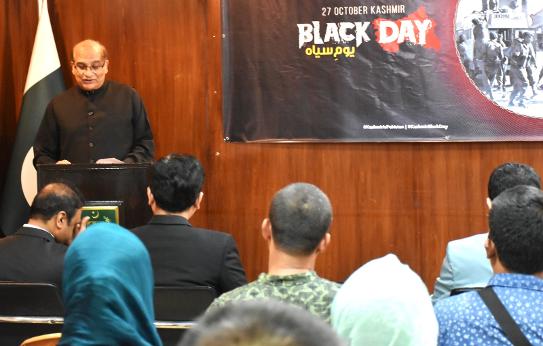
POBNEWS24, DHAKA, October 27, 2026: The longstanding conflict, concerns over fundamental rights and restrictions on civil liberties in Indian-administered Jammu and Kashmir remain at the centre of international attention, as the people of the disputed territory continue to face a challenging human rights situation, according to Pakistan. The issue was highlighted at an event organized by the Pakistan High Commission in Dhaka on Tuesday to observe Kashmir Black Day, with renewed calls for the Kashmiri people’s right to self-determination and a peaceful, just and lasting resolution of the dispute.
Pakistan High Commissioner to Bangladesh Imran Haider welcomed members of the Pakistani community, friends of Pakistan and representatives of the media who attended the event.
Messages from Pakistani President Asif Ali Zardari, Prime Minister Muhammad Shehbaz Sharif, and Deputy Prime Minister and Foreign Minister Senator Mohammad Ishaq Dar were read out during the programme.
The messages described October 27, 1947, as a significant and tragic date in the history of Jammu and Kashmir. On that day, Indian forces landed in Srinagar, marking a pivotal moment in the region’s protracted conflict. Pakistan’s leadership reiterated that the Kashmiri people’s right to self-determination remains unfulfilled and emphasized the need to uphold relevant United Nations Security Council resolutions concerning the dispute.
The messages also paid tribute to the sacrifices and resilience of the Kashmiri people and their continued aspirations for justice, dignity and freedom.
Expressing serious concern over the human rights situation in the territory, the Pakistani leadership highlighted restrictions on fundamental freedoms, the detention of Kashmiri political leaders and activists, and other challenges affecting civil liberties.
The messages also criticized India’s unilateral actions of August 5, 2019, which changed Jammu and Kashmir’s constitutional and legal status. Pakistan called on the international community, particularly the United Nations and international human rights organizations, to play a meaningful role in protecting the fundamental rights of the Kashmiri people and facilitating a peaceful and lasting settlement of the dispute.
Reaffirming Pakistan’s moral, political and diplomatic support for the people of Indian Illegally Occupied Jammu and Kashmir (IIOJK), the leadership stressed that lasting peace and stability in South Asia are closely linked to the resolution of the Kashmir dispute in accordance with relevant UN Security Council resolutions and the aspirations of the Kashmiri people.
Pakistan reiterated its commitment to advocating the legitimate rights of the Kashmiri people, including their right to self-determination, at relevant international forums.
A photo exhibition was also organized as part of the event, highlighting the hardships faced by the Kashmiri people and depicting alleged human rights violations and restrictions on freedom of expression in the territory. Participants showed keen interest in the exhibition, which sought to draw attention to the humanitarian and civil liberties dimensions of the dispute.
Through the observance of Kashmir Black Day, the Pakistan High Commission sought to renew international attention to the longstanding dispute and underscore the importance of human rights protection, the fulfilment of the Kashmiri people’s political aspirations and a peaceful resolution in accordance with relevant international frameworks.
To mark the day, a protest meeting was also held in front of the National Press Club on behalf of Nawab Sir Salimullah Academy. Abdul Jabbar Khan spoke there.