

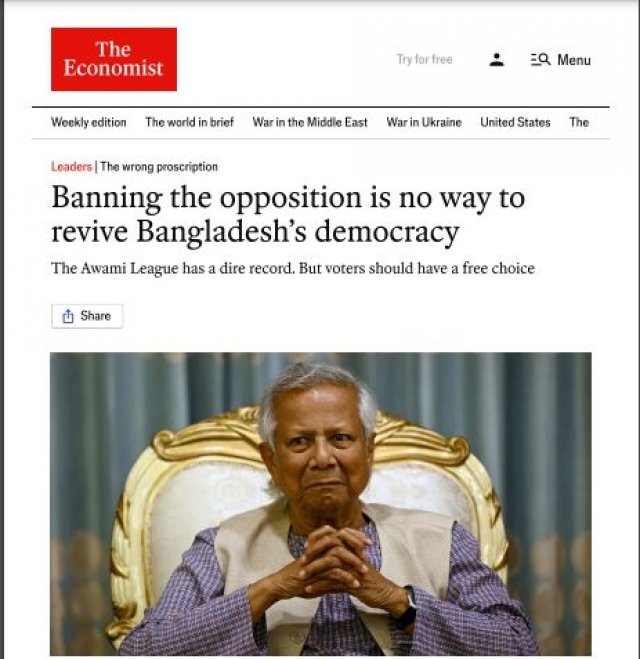
POBNEWS24, Desk report Dhaka June 27, 2025 : Recent decisions by Bangladesh’s interim government have raised concerns among politicians and drawn international criticism. The decision to ban the activities of the ousted Awami League contradicts its promise to rebuild democracy. The ban, imposed through amendments to the controversial anti-terrorism law, is legally and morally questionable. It could reignite the old cycle of political revenge. With widespread public support still intact, the current government in Bangladesh should lift the restrictions on the Awami League and allow it to participate in elections, according to an opinion piece published in the British newspaper The Economist on Thursday.
The article, which was published in the Leaders section of the print edition of the Economist and was republished online as ‘Banning the opposition is no way to revive Bangladesh’s democracy’.
It says that within four years of Bangladesh’s independence in 1971, the country fell into a cycle of military coups and lost its way. The same trend is seen again in the so-called ‘second independence’ achieved through the movement last year.
An interim government led by Nobel laureate economist Dr. Muhammad Yunus took power, ending the 15-year rule of former Prime Minister Sheikh Hasina.
However, as the years passed, concerns have once again arisen about the future of the so-called new Bangladesh.
The Economist article mentions that Dr. Yunus’ government was given a very difficult task. The country’s democratic structure collapsed due to long-term misrule, corruption spread through cracks and extrajudicial beatings of government opponents were almost regular occurrences during the previous government’s tenure.
Although the economy showed extraordinary progress for a few days, it eventually lost its momentum. The situation became so fragile that one-fifth of the country’s youth became unemployed.
The Yunus-led government has made some progress. They have indicated that they will hold elections in February 2026. Inflation has come down, keeping the economy stable amid the recession, and international lenders have started providing new loans.
However, Bangladesh has leaned towards China in its foreign policy. Through this, the current government sees it as advantageous in terms of trade, investment and arms purchases. As a result, Bangladesh’s relations with the United States are at risk. On the other hand, India is unhappy with its closeness with Pakistan. What was a friendly relationship until last year, is now increasing tensions there. As a result, India has canceled a transit agreement, sent back Bangladeshi migrants and demanded renegotiation of a key water-sharing agreement.
Dr. Yunus’s important task now is to rebuild the country’s politics by getting Bangladesh’s political parties to agree on a new electoral system. However, intolerance is growing among political parties regarding this process. And the spark of this political discord is boiling over into chaos.
In mid-June, a group of people harassed a former election commissioner accused of involvement in the 2018 election fraud.
Earlier, in May, the interim government banned the Awami League from its activities. This created a huge controversy at home and abroad. While it was logical to bring the party’s top leaders to justice for corruption, it was thought that ordinary members of the party would have a chance to rebuild themselves. The ban was introduced through a controversial amendment to the anti-terrorism law, which is legally and morally questionable. It could revive the old cycle of political revenge.
The current Yunus government in Bangladesh should lift the restrictions on the Awami League and allow them to participate in elections. They still have widespread public support.
Even if they are allowed to run their activities independently, the Awami League is unlikely to win the elections. However, their presence in parliament will hold the winners accountable. Reconciliation is needed instead of revenge to build a new Bangladesh.