
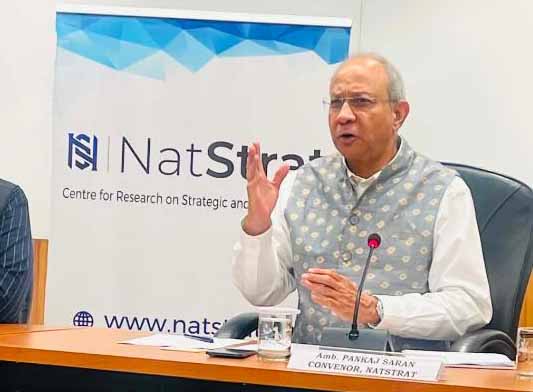
POBNEWS24, Dhaka May 12, 2026 : Pakistan has become diplomatically stronger after Sindoor due to America’s renewed engagement with Islamabad. Pakistan’s recent visibility is more due to its opportunistic utility to Washington during the Iran crisis than its strategic importance. It has repeatedly maintained itself by making itself available to larger powers, especially the United States. Such an absurd notion has no value, says Pankaj Saran, a former High Commissioner to Bangladesh and former Deputy National Security Advisor to India.
He said the main lesson of the past year was very clear. In an increasingly transactional and volatile world, India needs to be flexible in its partnerships and rely primarily on its own strengths. He argues that Operation Sindoor was the moment when India openly accepted this reality.
He made the remarks at an exchange of views with Bangladeshi diplomatic journalists visiting Delhi and Mumbai at Sushma Swaraj Bhavan on Friday.
Pankaj Saran believes that India has fundamentally changed the rules of engagement with Pakistan in a wide-ranging interview. The veteran diplomat argues that the “Operation Sindoor” operation was not just a military success, but an ideological shift that ended Pakistan’s long-held belief that its nuclear arsenal could provide an indefinite cover for cross-border terrorism.
But he argues that strategic expediency does not translate into long-term prestige or legitimacy. “If mediation were the measure of national prestige, Qatar and Oman would have become superpowers,” he observes, suggesting that Pakistan’s efforts to project itself as a custodian of regional stability remain fundamentally unreliable.
Pankaj Saran compares Pakistan’s trajectory with India’s post-independence evolution. He said India was built on strategic autonomy and resistance to external pressure, while Pakistan has mastered the art of subjugation. According to him, Islamabad’s security establishment still defines itself through its hostility towards India, a mentality he called deeply ingrained in the Pakistani state structure.
The former diplomat argues that the biggest strategic consequence of Sindoor was psychological. For decades, Pakistan had nurtured the belief that India, on the brink of nuclear weapons, would never dare to strike deep. He said Sindoor “punched that ideology in the face.” India had shown that nuclear blackmail would no longer deter retaliatory strikes against the terrorist infrastructure or its sponsors.
Pankaj Saran also argues for India’s decision to suspend the “Indus Waters Treaty” after the attacks that provoked Sindoor. He revealed that frustration had been building within the Indian establishment for years over Pakistan’s repeated misuse of dispute resolution mechanisms. In his view, Islamabad had used the agreement as a weapon to obstruct Indian projects while at the same time benefitting disproportionately from its terms. The Sindh Pact had merely created a political opportunity to act on pent-up resentment.
On the question of future terror attacks, Pankaj Sharan was not ambiguous about India’s evolving policy. He said the government had made it clear that any major attack linked to Pakistan would be retaliated by India alone, without waiting for international sanction. “We will not look back,” he said, underscoring the “new normal” he had publicly declared.
The interview extended beyond Pakistan. Sharan argued for India’s multi-faceted foreign policy, arguing that New Delhi was right to refrain from becoming a frontline state against China despite Western pressure. He said recent global turmoil has vindicated India’s policy of maintaining ties with rival power centres from Russia to the US and from the Gulf to East Asia.
On China, he advocated for stable engagement and gradual stabilisation of relations and warned against viewing Beijing solely from a Western strategic perspective. He added that talks of economic ‘decoupling’ from China have effectively collapsed under the pressure of global realities.
According to Sharan, the key lesson of the past year is clear. In an increasingly transaction-dependent and volatile world, India needs to be flexible in its partnerships and rely primarily on its own strengths. He argued that “Operation Sindoor” was the moment when India openly acknowledged this reality.
The exchange of views with visiting diplomatic journalists was also attended by former diplomats serving in Dhaka and Myanmar.