
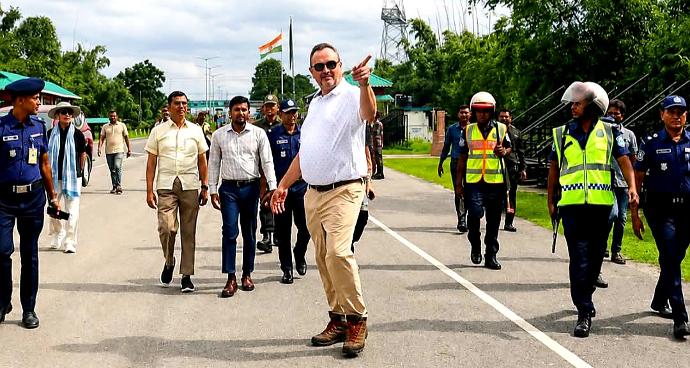
POBNEWS24, Dhaka Sept 1, 2026 : On the second day of his three-day visit to North Bengal, US Ambassador to Bangladesh Brent T. Christensen visited the Banglabandha land port and zero point on the India-Bangladesh border in Tentulia, Panchagarh. On Monday morning, he visited various activities at the border area and land port. He was accompanied by his wife Dean Dow and US embassy officials.
The ambassador’s visit provided an opportunity to observe the geographical importance, commercial activities, local economy and the reality of people’s lives along the border in North Bengal. Banglabandha is an important land port in the northwestern region of Bangladesh. This region also has special importance in terms of regional communication and trade with India, Nepal and Bhutan.
From Mahananda River to Banglabandha Zero Point According to the itinerary, the ambassador first visited the historical Mahananda River area of Tentulia in the morning. Later, he went to Banglabandha Land Port. There, he visited various activities and infrastructure of the port and observed the situation in the related area. Then, he went to the Zero Point of the Bangladesh-India border.
While at the Zero Point, the US ambassador was seen enjoying the natural beauty of the border area. He took pictures on his mobile phone and captured various scenes of the border area. His entourage also enjoyed the beauty of the border area at this time.
An important center for trade and regional communication
The Banglabandha Land Port is an important commercial gateway for the communication between Bangladesh, the northeastern region of India and North Bengal. Due to its geographical location, there is a possibility of trade and communication between Bangladesh and Nepal and Bhutan in addition to India through this border.
Those concerned believe that the issue of the economy and border trade of the northern region has also gained importance during the ambassador’s visit through the border inspection. The importance of Banglabandha is increasing day by day, especially in terms of infrastructure, goods transport, border management and regional connectivity.
Several more programs on the second day of the visit
After visiting Banglabandha and Zero Point, the Ambassador visited various places in Panchagarh. As part of the day’s program, he visited Panchagarh District Hospital and Panchagarh Rocks Museum. At the district hospital, he inquired about healthcare activities and handed over equipment and training models for maternal and newborn healthcare with US assistance.
After Panchagarh, the Ambassador headed for Thakurgaon. The tour also includes programs to get acquainted with the local economy, tea industry and traditions. Later, he visited the plains tea gardens and tea processing factories in the Baliadangi area of Thakurgaon. He spoke to the workers there and learned about the process of collecting tea leaves.
US Ambassador Brent T. Christensen’s three-day visit includes five districts of North Bengal – Nilphamari, Lalmonirhat, Panchagarh, Thakurgaon and Dinajpur. The tour, which began on August 30, will end on Monday, September 1.
On the first day of the visit, he visited the Teesta Barrage Project in Nilphamari and Lalmonirhat. There, he discussed with the officials concerned about the irrigation system, Teesta water distribution and flood control and management. He also visited the barrage control room.
Then, on the second day, he visited the Mahananda River in Panchagarh, Banglabandha Land Port and Zero Point on the Bangladesh-India border. On the third day of the visit, he visited various historical, cultural and industrial establishments in Thakurgaon and Dinajpur.
According to diplomatic observers, a foreign ambassador’s visit to a district bordering India is not just a formal visit; it provides an opportunity to directly observe the economy, border trade, infrastructure and people’s lives in remote areas of the country.
Especially, visiting an important border and land port like Banglabandha is important in understanding the commercial potential of the northern region and the reality of regional connectivity. The northern region of Bangladesh shares a direct border with India and is close to Nepal and Bhutan, and this region also has regional commercial importance.
In addition to diplomatic activities, the Ambassador’s visit to North Bengal this time will also focus on local economy, agriculture, water, health, border and trade issues. From Teesta Barrage to Banglabandha border and from Panchagarh health and tourism sites to Thakurgaon tea industry, the US Ambassador is getting acquainted with the multidimensional reality of North Bengal by visiting various sectors.