

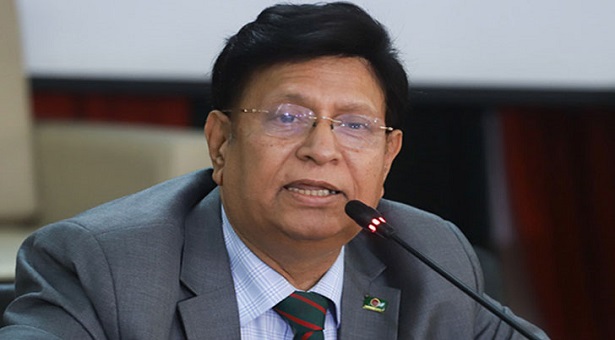
POBNEWS24, Desk report Dhaka Jan 1, 2026 : In an exclusive interview to the United News of India, Prof AK Abdul Momen, who served as Bangladesh’s foreign minister from 2019-2024, said that the Bangladesh-Pakistan-China axis building up could prove deeply destabilising, not just for Dhaka, but for the wider South and South East Asia
angladesh risks being pulled into a dangerous geopolitical and ideological vortex as it aligns itself too closely with Pakistan and China and allows religious extremism to flourish at home, a former foreign minister of the country has warned, painting a bleak picture of economic stagnation, diplomatic isolation and social rupture in the post–Sheikh Hasina era.
In an exclusive interview to the United News of India, Prof AK Abdul Momen, who served as Bangladesh’s foreign minister from 2019-2024, said that the Bangladesh-Pakistan-China axis building up could prove deeply destabilising, not just for Dhaka, but for the wider South and South East Asia.
Depending on the nature of this axis, many scenarios may unfold,” Prof Momen said, outlining a cascade of risks which range from provoking pressure or sanctions from the United States; losing credibility in international forums; alienating India and other liberal neighbours, and, most ominously, sliding toward jihadist radicalism and authoritarian rule.
Bangladesh’s foreign affairs adviser Md Touhid Hossain had earlier this month said it is “strategically possible” for Dhaka to join a regional grouping with Pakistan that excludes India. It is also known that the BNP during the Late Prime Minister Begum Zia’s reign had close ties with both China and Pakistan and had allowed ISI to run terror camps aimed at destabilising India’s northeast.
At stake, Momen suggested, is the very identity of Bangladesh — a country born out of a bloody war of liberation in 1971, founded on secular nationalism and linguistic pride, now confronting the possibility of being recast as what he described as a “jihadi country,” where women would be relegated to second-class status and democratic institutions hollowed out.
Depending on the nature of the Bangladesh-Pakistan-China axis … the following may happen … it (Dhaka) may be encouraged to be hostile to India, leading to serious negative consequences (including) even border fighting and incursions, face increasing pressure and even sanctions from USA depending on its closeness and dependence to China, lose it’s acceptability in international forums, … may turn into a jihadi country where women will be considered as second class citizens,” Momen told UNI.
Prof. Momen’s warnings come amid growing anxiety over Bangladesh’s political trajectory following the exit of Sheikh Hasina, who dominated the country’s politics for more than two decades.
Whatever her critics said about her intolerance of dissent, the former foreign minister argued, she represented a rare constant in a volatile political landscape: a secular, non-communal leader who prioritised economic growth and social welfare across religious and ethnic lines.
In the post-Hasina era, the rise of radicals and jihadis is very real,” he said.
“This will destroy the national spirit of humanity and lead to social fragmentation based on religion or belief.” He pointed to a series of brutal recent killings, including the public torture and burning of a garment worker, Dipu Das, and a daylight lynching carried out with stone as evidence of what he called a “medieval” descent into violence.
Momen warned Bangladesh’s communal turn could have spill-over effects in India, exacerbating pressures on Muslim minorities and deepening regional mistrust. “Jihadi radicals are a real threat to social and political stability — in Bangladesh and beyond,” he said.
Against this grim forecast, Prof. Momen contrasted what he called the “golden period” of Sheikh Hasina’s rule. Over 21 years in power, he said, Bangladesh had transformed itself from a “bottomless economy” into a fast-growing developing nation, earning praise from institutions like the United Nations and accolades from publications such as The Wall Street Journal, which once described the country as a “standard-bearer of the South.”
Under Hasina, Bangladesh sustained an average annual growth rate of 6.6 per cent between 2009 and 2024, more than double the pace of earlier decades. Poverty fell sharply, from 42 per cent in 2009 to 17 percent in 2023, while the size of the economy expanded from $90 billion in the mid-1990s to nearly $480 billion.
Prof. Momen attributed these gains to what he dubbed “Hasinaeconomics”: a twin focus on rapid growth and social welfare. Her government pushed universal electricity, mass school enrollment, women’s participation in the workforce, digital skills and large-scale infrastructure, while also rolling out extensive social protection programs for the elderly, widows, students and the poorest families.
As foreign minister, Momen said, he and his colleagues tried to align Bangladesh’s development ambitions with a careful diplomatic posture: “friendship to all, malice to none,” coupled with a “neighborhood first” approach. Economic diplomacy, public diplomacy and a doctrine of regional peace and stability were designed to attract investment, diversify exports and keep Bangladesh out of great-power rivalries, pointed out Momen.
That balance, he fears, is now under threat and despite lip service may remain so.