

POBNEWS24, Dhaka Aug 31, 2025 : National Consensus Commission Vice-Chairman Ali Riaz has called for commitments from political parties regarding the welfare and independence of journalists.
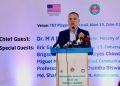
He made this call to journalists as the chief guest at a discussion meeting organized on Sunday (August 31) on the report of the Media Reform Commission and the next situation.
The discussion meeting was organized by the Broadcast Journalist Center (BJC) in collaboration with BBC Media Action at the Daily Star Bhaban.
Urging journalist organizations to take commitments from political parties, Ali Riaz said, “When politicians come to power, they will have to come to you. Catch them now. Ask them what promises they are making for the welfare of journalists. Ask them to make these commitments.”
He also said that no organization provides safety training for media workers going to risky places. The Media Reform Commission is not needed for this.
Ali Riaz also said that the question of wage board arises in the context of professional responsibilities. Many have said that wage board is not implemented, so what is the benefit of having a wage board? There is no benefit. Why is wage board not implemented? Because, the organization has not become a profitable business organization in any way. A shopkeeper runs a shop, if it is not profitable, he closes it. Why do media owners run media outlets despite not being profitable? There must be a reason. How can these institutions become profitable – raise that question.
He also said that the benefits that are supposed to be given to you from a professional perspective, that is, the opportunities that are supposed to be created for performing duties, are not done by the owner as soon as they are given a job, because the owner knows that even after treating you this way, you will serve this government, regime or ideology or you will stay. And he (the owner) will take advantage of this. That is why it is difficult to establish independence by continuing the type of ownership that has been created, whether it is newspapers, television or radio.
The vice-chairman of the consensus commission also said that some journalists are taking advantage of mob violence. This is not the case of pushing someone out and putting someone in office. If the next person is not there, the previous person will not have the courage.
He also said that in a country where citizens do not have legal protection, where extrajudicial killings, disappearances, and persecution occur, will you get legal protection if you have a journalist’s ID card? Is it possible? I don’t think it is possible.
Also present at the discussion meeting chaired by BJC Chairman Rezwanul Haque were Salehuddin, Executive Editor of Daily Ittefaq, Md., a teacher at Jagannath University. Minhaj Uddin, senior journalist Hasnain Khurshed, vice-president of Bangladesh Women Journalists Center Munima Sultan, president of Dhaka Union of Journalists (DUJ) Shahidul Islam, general secretary of Dhaka Reporters Unity (DRU), Mainul Sohel,
BJC trustee and CEO of Jamuna TV Fahim Ahmed, BJC trustee director Talat Mamun, treasurer Manas Ghosh.
BJC member secretary Ilias Hossain and BBC Media Action country director Md. Al Mamun delivered the welcome speech and BJC executive Milton Anwar presented the keynote speech at the discussion moderated by Ilias Hossain and Shahnaz Sharmin.
In his presidential address, BJC chairman Rejoanul Haque said, the media is the fourth pillar of the state. Past governments have used the media. We ourselves sometimes allowed it to be used. Are we journalists or political activists? As long as this situation persists, the government will want to use us, we will be used. We have lost the trust of the people long ago.
Salehuddin, executive editor of the Daily Ittefaq, said that the entire Bangladesh needs reform. But we sit around with small issues like media reform. But the crisis is that there is no institution to reform the entire Bangladesh. The political parties and affiliated institutions of Bangladesh are not suitable for reform. The crisis we have now, the crises that have been going on for so long, are hurting the quality, dignity, and livelihood of our journalism through tout journalism, blackmailing journalism, and broker journalism. Which we have been doing for a long time and are still doing. We have destroyed our institutions through this broker journalism.
Commenting that the government considers the Media Commission a failure, Jagannath University teacher Md. Minhaj Uddin said, the government will not set up a Media Commission, let alone a Broadcasting Commission. Because if they do these things, the authority of the Ministry of Broadcasting and the Ministry of Information will be reduced.
Senior journalist Hasnain Khurshed said that if we want to build a democratic state without the media, it will be weak. He said that the media should be given priority in reform. The media should be kept away from the interference of the owners.
Dhaka Union of Journalists (DUJ) President Shahidul Islam believes that there is a deficiency in the basic proposal of the Media Reform Commission. He said that this situation should be resolved by talking to the stakeholders. At this time, he also raised the question of what is the benefit of having a wage board if it is not implemented.
Dhaka Reporters Unity (DRU) General Secretary Mainul Hasan Sohel said, we have to decide first, am I a journalist or a political figure. We have to get our hands on this foundation first.