

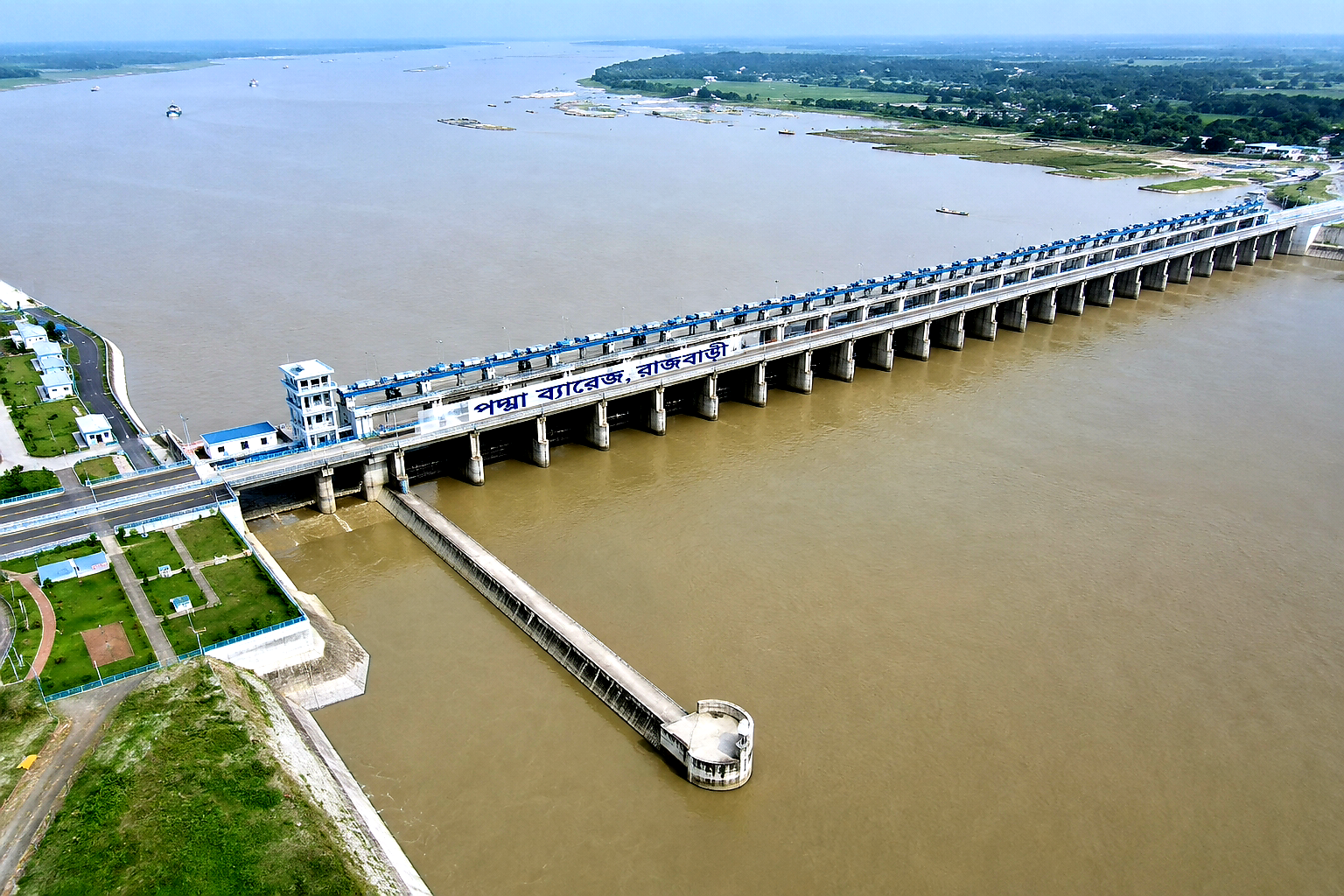
POBNEWS24, Dhaka May 13, 2026 : The Padma Barrage project received final approval at the meeting of the Executive Committee of the National Economic Council (ECNEC). The total proposed cost of the project is Tk 33,474.45 crore. This is the first meeting of the Executive Committee of the National Economic Council (ECNEC) of the new BNP-led government.
The project was approved at the ECNEC meeting held under the chairmanship of Prime Minister Tarique Rahman at the Cabinet Room of the Bangladesh Secretariat on Wednesday.
A total of 16 projects were presented at the ECNEC meeting. Out of these, the Padma Barrage project was kept on the agenda number 11. Earlier, the project was presented at several ECNEC meetings. During the interim government, the project was presented at the ECNEC meeting but was not approved.
It is planned to restore the flow of fresh water by conserving and controlling the water of the Padma River during the dry season through the implementation of the approved Padma Barrage project. The project will be implemented from July 2026 to June 2033.
Those concerned said that if the project is implemented, about 37 percent of the country’s people will directly benefit, salinity will decrease, dead rivers will come back to life, and positive changes will come to agriculture, fisheries and the environment.
India built the Farakka Barrage in West Bengal in 1975 to divert 35,000 to 40,000 cusecs of Ganga water to the Bhagirathi-Hooghly River during the dry season and to improve the navigability of the Kolkata Port connected to the Bay of Bengal in the south. As a result of the withdrawal of water upstream of the Farakka Barrage, the flow of the Padma River in Bangladesh has drastically reduced and the Hisna-Mathabhanga, Gorai-Madhumati, Chandana-Barashia, Ichamati and Baral rivers in the southwestern and northwestern parts of Bangladesh have dried up.
An official present at the meeting, who did not wish to be named, told this reporter that the government is undertaking the Padma Barrage project in the first phase to save Bangladesh from the negative impact of the Farakka Barrage. The Ministry of Water Resources has said that the overall implementation of this project will cost 50,443 crore taka. The main objective of the Padma Dam project is to ensure the flow of fresh water in the river systems of the southwestern and northwestern regions of the country by conserving and controlling the water of the Padma River during the dry season.
However, the biggest uncertainty in the implementation of the project has been created by the geopolitical reality related to India’s Farakka Barrage. The Ganges Water Sharing Agreement signed in 1996 is expiring in December this year.
According to relevant sources, after the construction of the Farakka Barrage by India in the 1970s, the water flow in the Bangladesh part of the river has drastically reduced during the dry season. As a result, salinity in the rivers and canals of the southwestern region is increasing at an alarming rate. This situation is having a negative impact on agriculture, fisheries, navigation, availability of fresh water and biodiversity of the Sundarbans.
As a result of this project, India’s monopoly in terms of water diplomacy and regional influence may decrease to some extent.
It is worth noting that the main obstacle to the implementation of the Ganga Treaty during Sheikh Hasina’s rule was the Mamata Banerjee government in West Bengal. During her tenure, there were complications in getting a fair share of water as per the treaty, and the issue has been raised many times in the Delhi meeting. Recently, when a group of Bangladeshi diplomatic journalists visited India, Foreign Secretary Vikram Mishri hinted at the issue in a meeting with them. In the meantime, Bangladesh has given final approval to the construction of the Padma Barrage.
The image in the news is fictional