

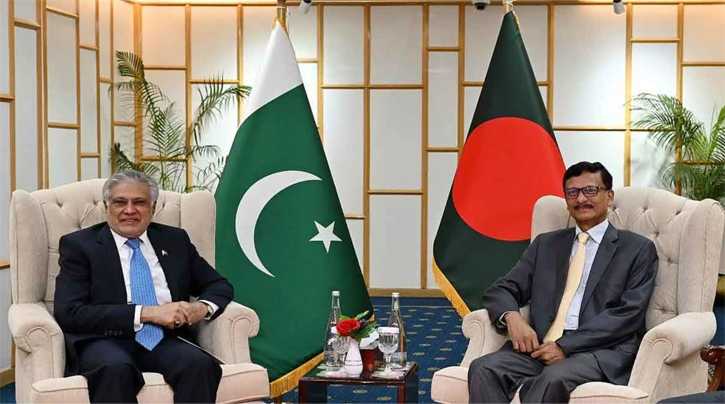
POBNEWS24 Desk report Dhaka Dec 6, 2025 : A tripartite initiative has recently been started involving Bangladesh, China and Pakistan. It may be expanded to other countries in the region and beyond. Pakistan’s Deputy Prime Minister and Foreign Minister Ishaq Dar made this comment at the ‘Islamabad Conclave’ forum on Wednesday.
At the forum, Ishaq Dar said, “We are not in favor of the policy of ‘if one wins, the other loses’. We have always emphasized the need for cooperation instead of conflict.”
Pakistan mainly wants to create an alternative bloc in South Asia with China. They want to do this at a time when the main regional alliance in the region, the South Asian Association for Regional Cooperation (SAARC), has become almost ineffective. The organization has lost its life due to tensions between India and Pakistan.
Last June, diplomats from Bangladesh, China and Pakistan held trilateral talks in Kunming, Yunnan Province, China. Regional stability, economic development and improving the quality of life of the people were the topics of discussion. However, they stressed, “This discussion was not aimed at any third party.”
But Ishaq Dar’s comments on Wednesday came at a time when regional tensions in South Asia have recently increased. In May, nuclear-armed neighbors India and Pakistan engaged in four days of reciprocal air and drone attacks. This has further complicated the overall situation in the region.
On the other hand, in August last year, Bangladeshi Prime Minister Sheikh Hasina was ousted from power in a student uprising. Relations between Dhaka and New Delhi have since deteriorated significantly. After being ousted, she is in exile in India. The International Crimes Tribunal sentenced Sheikh Hasina to death last month for crimes against humanity. But despite repeated requests from Dhaka, New Delhi has not agreed to send Sheikh Hasina back.
In such a backdrop, will Pakistan’s attempt to create a new bloc with other countries in South Asia, excluding India or at least limiting its influence, succeed? Apart from Bangladesh, India and Pakistan, the other SAARC countries are Sri Lanka, Nepal, Maldives, Bhutan and Afghanistan.
At the Islamabad conclave, Ishaq Dar said that the main goal of Pakistan’s trilateral initiative with Bangladesh and China is to increase mutual cooperation on issues related to their interests. This initiative can be expanded to include more countries and regions.
In Ishaq Dar’s words, “As I have said before, different groups or organizations can be created on issues ranging from economy to technology and connectivity.”
The Pakistani leader also said, “We need our own national development. Besides, regional priorities cannot and should not be hostage to the rigid attitude of any country. You may understand which country I am talking about.” Ishaq Dar clearly hinted at India here.
Noting that a “constructive dialogue” process between Islamabad and New Delhi has been stalled for over 11 years, Ishaq Dar said that other regional neighbours also have “fluctuating relationships” with India.
Ishaq Dar said Pakistan envisions a South Asia where there is relationship and cooperation instead of division, economies grow in unison, disputes are resolved peacefully on international standards, and peace is maintained with dignity and respect.
According to Rabia Akhtar, director of the Centre for Security, Strategy and Policy Research (CSSPR) at the University of Lahore, Pakistan’s proposal so far seems “more ambitious than effective.”
“With this proposal, Pakistan has expressed its desire to reshape and diversify regional cooperation at a time when SAARC is stagnant.”
SAARC was launched in 1985 at a summit in the Bangladeshi capital Dhaka. Bangladesh, Bhutan, India, Maldives, Nepal, Pakistan and Sri Lanka were its founding members. Afghanistan joined in 2007.
According to the SAARC website, the main objectives of the organization are to improve the welfare and quality of life of the people of South Asia, accelerate economic growth and promote cultural development.
But despite its ambitious goals, the organization has not been successful in fulfilling these objectives in the last four decades. The main reason for this is the long-standing strained relations between India and Pakistan. The two neighboring countries gained independence from British rule through the partition of the subcontinent in 1947. They have since fought three full-scale wars.
The 19th SAARC summit was scheduled to be held in Islamabad in 2016. But after India announced that it would not participate, the summit was postponed indefinitely. New Delhi withdrew from the Islamabad summit after a deadly attack in Indian-controlled Kashmir. The country claims that Pakistan was behind the attack.
The last summit of the regional organization was held in Kathmandu, the capital of Nepal, in 2014. According to analysts, although SAARC is currently inactive, the organization can do a lot for the region if India and Pakistan want it.
Why is SAARC important
According to the data of 2025, the total population of the SAARC countries is more than 2 billion. With such a large population, South Asia has become the most densely populated region in the world. But trade and commerce between the countries of South Asia is very limited.
Source: Al-Jazeera