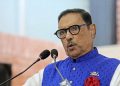


POBNEWS24, Dhaka, Dec 18, 2025 : Bangladesh has reacted strongly to India’s recent statement calling for ‘fair and participatory’ elections in Bangladesh. At a press conference on Wednesday, Foreign Affairs Advisor Towhid Hossain said there is no need for India’s ‘advice’ on Bangladesh’s elections.
He said, we do not seek advice from our neighbors on how the elections will be held in Bangladesh. He described Delhi’s role in this regard as ‘completely unacceptable’.
Earlier, the same day, a press release issued by the Indian Ministry of External Affairs called for holding a fair, inclusive and credible election in Bangladesh. Three days earlier, another release issued on December 14 made a similar statement.
According to international relations analysts, there are at least three important reasons behind Bangladesh’s strong reaction. These include India’s supportive stance during three controversial elections held in Bangladesh in the past, not reinstating ousted Prime Minister Sheikh Hasina, and doubts about India’s role in rehabilitating the Awami League.
The last three elections during Prime Minister Sheikh Hasina’s tenure were controversial for various reasons. There are allegations that India played a role, sometimes directly, sometimes indirectly, in legitimizing these elections.
International relations analyst and researcher Altaf Parvez raised the issue of the one-sided elections of 2014. According to him, the incident of ‘hospitalizing’ the then chairman of the party, HM Ershad, before those elections was also important to bring the Jatiya Party to the elections.
The then main opposition party, BNP, boycotted the elections in protest against the abolition of the caretaker government system from the constitution. Although the Jatiya Party also announced a boycott initially, the party later participated in the elections under the leadership of Ershad’s wife, Rowshan Ershad, while Ershad was in the hospital.
Although 153 Awami League candidates were elected unopposed in those elections, the Awami League claimed it as a ‘participatory election’ due to the participation of the Jatiya Party.
During the tension surrounding the elections, the then Indian Foreign Secretary Sujata Singh visited Bangladesh. She also met with Ershad. Altaf Parvez said that Ershad has been removed from the opposition role and India’s Foreign Secretary has played a direct role in this.
According to him, India has directly supported and approved the Awami League government after the one-sided elections of 2014 and the massive rigging in the 2018 elections and helped it cross the electoral threshold.
Many analysts believe that it is because of this support from India that the United States and Western countries did not publicly raise strong objections to the results of the disputed elections.
Even after the 2024 elections, several countries, including India, met Sheikh Hasina and congratulated her. A few days later, Awami League General Secretary Obaidul Quader said that even though the opposition tried to sabotage the elections with the help of foreign forces, ‘India stood by her side’.
Referring to this, Foreign Affairs Advisor Towhid Hossain said that India had a very sweet relationship with the governments that were in power for the past 15 years. But then they did not utter a single word about the farcical elections. Now, when we are moving towards good elections, there is no need to admonish us.
Amena Mohsin, a professor of international relations at Dhaka University, believes that it is natural for India to react to such comments given its questionable role in the past. She questions why these words are coming from India when inclusive elections are being talked about today?
Doubts over the rehabilitation of Sheikh Hasina and Awami League.
Prime Minister Sheikh Hasina, who was ousted from power in the face of a mass uprising on August 5 last year, left Bangladesh and has been staying in India since then. The Bangladesh government has repeatedly asked her to return for trial, but India has not responded to this.
Meanwhile, there are allegations that leaders and activists of the banned Awami League have taken refuge in various places in Bangladesh, including Kolkata, India. The interim government claims that the party is trying to destabilize Bangladesh from there.
A section of analysts believe that India’s repeated emphasis on ‘participatory elections’ is a hint to bring the Awami League back to the elections. Amena Mohsin said that generally speaking, it seems that India is talking about including the Awami League in the elections.
On the other hand, Altaf Parvez believes that the participation of all parties is essential to bring about political stability out of the long-standing politics of revenge. However, even though the United States says this, such a reaction is being seen in India because India’s role in the past was not neutral.
In his words, even though India is speaking the truth, people assume that the goal is to bring Awami League back to the elections.
Sahab Enam Khan, a professor in the Department of International Relations at Jahangirnagar University, believes that India’s close relationship with Awami League is linked to the country’s national interests.
He said that efforts are being made to rehabilitate Awami League in politics to fill the gap created by the role of Awami League in India’s domestic politics and the trust that BJP has in politics related to Bangladesh. This can also be considered an important political achievement for India.
According to analysts, not only the elections but also India’s ‘unwanted’ comments on various internal issues of Bangladesh and anti-Bangladesh statements in the media are also a reason for this strong reaction.
In addition, analysts also believe that India has not shown much interest in improving Bangladesh-India relations in the last 16 months after the fall of Sheikh Hasina.