

POBNEWS24, Dhaka June 13, 2026 : History, language, culture, economy and memories of the Liberation War – all of them are multidimensional. But this relationship was not always straightforward. The relationship between the two countries has seen ups and downs many times due to the impact of border killings, migration, river water distribution, trade discrimination and internal political changes. However, after the political transformation of Bangladesh through the August 5, 2024, mass uprising, the interim government led by Muhammad Yunus came to power, Dhaka-Delhi relations entered an extremely uncomfortable stage. The coldness of mutual distrust that had developed between the two countries as a result of the change in the long-known political reality did not completely disappear.
Later, when relations were about to normalize after the departure of the interim government through elections and the rise of BNP to power this year, the “push-in” came to the fore. After the newly elected government in Bangladesh took office, both countries seemed to be moving towards a pragmatic stance. After the BNP government took office, diplomatic contacts between the two countries increased, high-level meetings were held, and both sides understood that there was no alternative to mutual cooperation as neighboring states. But at such a time, immediately after the Hindutva party won the West Bengal assembly elections and formed the state government, incidents of push-ins or forcibly sending people across the border to Bangladesh began to come to light, and new pressure was created on the relations between the two neighboring countries.
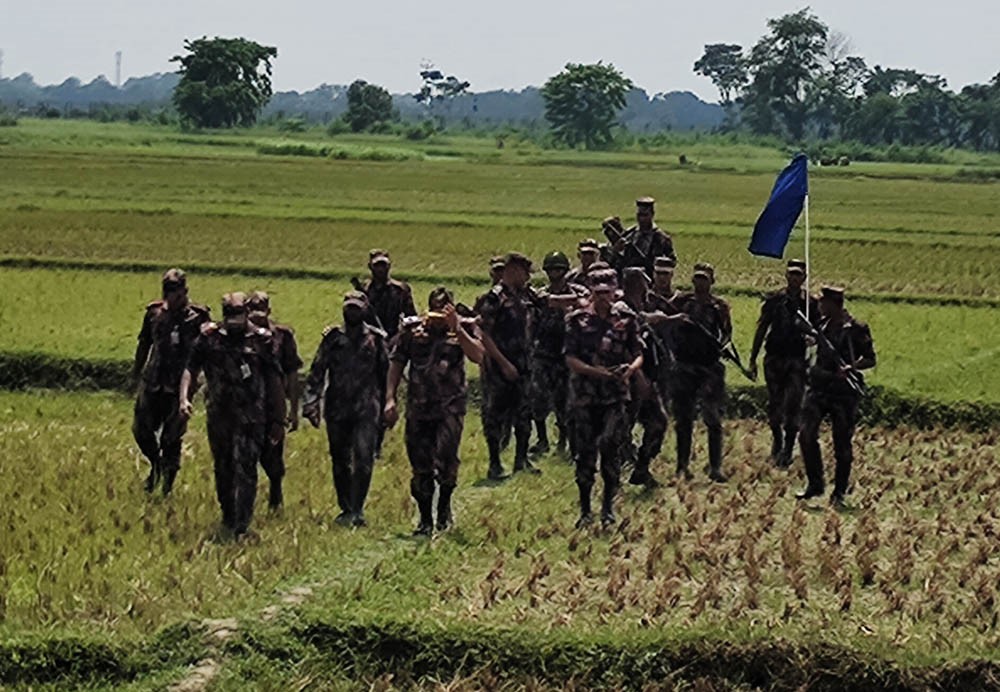
When a person is forcibly pushed from one country to another, there is no minimum humanity in that process. The Indian Border Security Force (BSF) is doing the same in the dark of night. However, the Bangladesh Border Security Force (BGB) is preventing it, but we can only learn about the incidents from the media sources where it is able to prevent it. It is difficult to say for sure whether anything else is happening.
Because the total land border of five Indian states with Bangladesh is about 4,156 kilometers long. It is the fifth longest land border in the world. The longest border of these five states is with West Bengal, which is about 2,217 km long. West Bengal’s 24 Parganas and Nadia districts are connected to Satkhira, Jessore and Jhenaidah districts of Bangladesh. Malda and Murshidabad regions form borders with Rajshahi and Chapainawabganj districts. North and South Dinajpur and Jalpaiguri regions are connected to Panchagarh, Thakurgaon, Dinajpur and Kurigram districts of Bangladesh.
The state of Assam has a border with Bangladesh of about 263 km, which is divided into two separate parts. The Cachar and Karimganj regions of Assam are connected to Sylhet and Moulvibazar districts. On the other hand, the Dhubri region of Assam is connected to Kurigram district.
Among other states, Bangladesh’s border with Tripura is 856 km long. Tripura’s West Tripura (Agartala), Sipahijala (Sonamura), Khowai and Unkoti (Kailashahar) regions coincide with the Comilla, Brahmanbaria, Feni, Chandpur, Moulvibazar and Habiganj districts of Bangladesh. In particular, Tripura’s capital Agartala is located right opposite the Akhaura and Bijoynagar regions of Brahmanbaria in Bangladesh.
The border with the state of Meghalaya is about 443 kilometers. The southern and southwestern Khasia Hills, Jaintia Hills and the eastern and western Garo Hills regions of Meghalaya coincide with the Sherpur, Netrokona, Sunamganj and Sylhet districts of Bangladesh.
The border with Mizoram is about 318 kilometers. Mizoram’s Mamit and Langtalai districts share a border with the remote hilly and forested areas of Rangamati and Bandarban districts of the Chittagong Hill Tracts region of Bangladesh.
It is difficult to say where in the vast border the Indian Border Security Force (BSF) is doing what. Especially after Assam, the situation at the border has become even more unpredictable in West Bengal, where the Hindutva party BJP has come to power. We see that people are being pushed into the Bangladesh border at gunpoint in groups. It can be assumed that the ignorant children in those groups are stunned with fear. They do not understand what their crime is, why they are being uprooted from their familiar environment and pushed towards an uncertain future. When hungry and thirsty children are trapped on the zero line of the border in the scorching heat, sometimes on the muddy ground soaked by rain, holding the hands of their parents, it calls into question humanity. The same is true of the elderly. At the end of their lives, these physically and mentally weak people are being driven away like animals. Many times, it is seen that these elderly victims of push-ins are seriously ill. There is no treatment available for these people suffering from various diseases related to old age at the zero line of the border. I see them lying under the open sky, exposed to sun, rain and storms day after day. This indescribable suffering is not only crippling them physically, but is also breaking them mentally forever. Where the international border is supposed to be a symbol of the sovereignty of two independent states, the push-in incident has turned it into a cruel torture chamber of statelessness.
Small children stuck on the zero line who are not getting enough food do not know what is being discussed between Delhi and Dhaka. An old man who is at the end of his life and wants a little peace and security, it is not clear to him which country’s administrative decision has brought him to stand next to the barbed wire of the border in the dark of night.
This human plight is not only a human pain, but also raises questions of international law and human rights. The 1948 Universal Declaration of Human Rights speaks of the right of every human being to dignity and security. The 1966 International Covenant on Civil and Political Rights (ICCPR) promises to protect the fundamental rights of people. According to the widely recognized principle of ‘non-refoulement’ in international law, no person can be forcibly returned in a way that would threaten his life, freedom or security.
Although Bangladesh and India are not parties to the 1951 Refugee Convention, they are not divorced from the fundamental principles of international human rights. The state has the right to control the border, but that right is not above human values. There is a specific Standard Operating Procedure or SOP for border management between Bangladesh and India. According to this rule, if an illegal intruder is caught at the border, he is supposed to be pushed back through a flag meeting and after confirming his proper identity, through legal process. But the BSF is trying to continue the unilateral push-in by showing the thumbs-up to that bilateral agreement.
Of course, a state has the right to arrange for the repatriation of illegally staying foreign nationals. But that process must be based on international rules and bilateral agreements. Pushing people unilaterally to the border without verification of citizenship, consular contact and consent of the country concerned cannot be acceptable.
The issue of push-ins or forcibly sending people across the border to Bangladesh emerged as the main topic of discussion at the 57th Director General-level bilateral meeting of Border Guard Bangladesh (BGB) and Border Security Force (BSF) held recently in the Indian capital Delhi. According to the information presented at the meeting, this crisis is no longer an isolated incident, but has taken the form of a well-organized and systematic process.
In the BGB-BSF meeting, Bangladesh clearly stated that such push-ins are illegal, anti-human rights and contrary to international law. Bangladesh’s position is that if someone is to be returned, they must be returned after verifying their citizenship and following an internationally recognized process. On the other hand, India claims that they are sending back illegal Bangladeshis following their own laws and existing procedures. India alleges that in many cases, the process is prolonged even after providing a list to Bangladesh. But according to BGB data, 2,479 people were sent to Bangladesh in eight months from May 2025 to January 2026, of whom 120 were Indian citizens. If this information is correct, then questions naturally arise about the citizenship verification process.
The recent situation is similar to the political reality of West Bengal. The issue has taken on a new dimension in the context of the BJP’s double engine government’s ‘detect, delete and deport’ or ‘3-D’ policy. However, history shows that using migration and border issues as political tools can lead to temporary political gains, but in the long run, it damages the relations of neighbors. This is even more true in the case of two close neighbors like Bangladesh and India.
Along with the push-in issue, border killings, drug and arms smuggling, human trafficking and unauthorized construction of infrastructure within 150 yards of the border have also come up for discussion. These are certainly important security issues. But the need for security can never negate humanitarian considerations.
The two countries now have an opportunity. The new environment of dialogue that has been created by overcoming the coldness in the post-August 2024 relations needs to be further strengthened. Because Bangladesh and India are not just neighbors to each other; They are each other’s essential partners in economic, geographical and strategic realities.